
Grayslake’s Fight against the T5 Data Center
If you’re plugged into happenings around Lake County, chances are you’ve already heard about the massive T5 data center that’s being built in the Grayslake Cornerstone property between Peterson Road and Alleghany Road, essentially adjacent to the large outdoor baseball/soccer park on Alleghany. The proposed site “covers up to 472 acres and can include no more than 10,100,000 square feet.” That’s ten million, one hundred thousand square feet.
According to the Grayslake T5 Fact sheet, updated August 25, 2026, the project was approved between September 2024 and May 2025 with “minimal public interest… during the 2024/2025 public approval process.” However, this seems to just mean that no one showed up to the board meetings. Notably, it seems that the Village never thought, “Hey, maybe we should tell the residents about this.” People are pissed. A Lake County Data Center Opposition Coalition has been formed, board meetings have been attended en masse, protests have been held, residents have organized talks at community centers and churches, a lawsuit has been filed, and even environmental activist Erin Brockovich made a post about it. In response, several surrounding governing bodies have expressed opposition, including the Village of Mundelein, Avon Township, and the Village of Round Lake Park, though they have no jurisdiction over the project itself. The Lake County Zoning Board of Appeals recently passed an 8-month moratorium on data center construction in unincorporated areas; however, they also do not have the power to stop this behemoth. But their official positions seem to reflect a process by which these surrounding communities listened to the public, considered the information, and opted to oppose based on the currently available information. You know… democracy.
Despite the pushback from the residents of Grayslake and surrounding areas, the Board has doubled down on their stance. They have held public comment sessions and pasted listening faces on, but they seem to be completely unmoved. On June 13, 2026, the first protest against the data center was held in Millenium Plaza. The board had canceled their meeting the previous week when people started planning to attend. During the next meeting on June 16, 2026, the boardroom was pre-packed with members of the Local 150 Union, who sat in every chair, signed up for most of the speaking slots, and sang “Oh Say Can You See” to drown out residents vocalizing objections prior to the meeting start. It was standing room only, most attendees had to stand in the hallway, and the Mayor announced a shortened speaking time, ensuring she cut off residents as soon as they hit two minutes. Subsequent meetings weren’t any better as the outrage grew. For instance, the speaking microphone ‘mysteriously’ broke and seemingly could not be replaced between meetings. Security measures were enacted. At one point, the Board announced a one-time extended public comment forum to be held at CLC; however, that was quickly cancelled after posted Facebook comments seemingly made threats to board members. Threatening people with harm is not okay, ever. But it’s also not okay to betray the residents who trusted you to make decisions about their community and ignore their objections when you disagree.
Primary Concerns
Electricity:
At the Data Center Educational Forum hosted by the Lake County Data Center Opposition Coalition, a representative from the Consumer Utility Board spoke about the impact on electrical pricing for residents. Electrical pricing is based on how much energy is expected to be consumed. As presented at the forum, the Independent Market Monitor reports that in the energy capacity auctions for 2025-2028, data center forecasts made up $21.3B or 45% of the capacity costs. With higher capacity needs, the price of electricity for everyone who uses it inevitably goes up. Across the country, people are anecdotally reporting higher electricity bills, and with data centers new on the scene, it’s hard not to point to them as a cause. AI is being built into everything, and its use is almost unavoidable. AI workloads can consume 1000x more electricity than a typical web search, and unless you specifically turn this feature off, the web hosts default to using AI.
Water:
A geologist presented information about the impact that the data center may have on the environment and local water supply. In short, the servers generate heat and require massive amounts of water to keep cool and stay functional. That water needs to come from somewhere and continuously flow through the miles of piping, valves, and joints across the facility. Even if the servers use a “closed loop” system in which the same fluid is continuously cycled through the facility, leaks can develop in the miles of pipes and would likely take a while to detect. Notably, the water will contain additives that are intended to make the cooling function more effective. Things like hydrofluorocarbons, PFAS, corrosion inhibitors, biocides, and glycol, all of which are dangerous environmental pollutants that will impact the soil and groundwater surrounding the facility. Because the T5 data center is being built in the middle of a wetland, this is of particular concern.
Health Effects:
On top of the long-term health impact of the forever chemical pollutants on the environment, there are additional concerns about the negative health effects of the data center on surrounding residents. Videos have popped up on social media recording the high-pitched humming sound emanating from other data centers, which can not only drive a person slowly insane but also damage hearing and the nervous system. There have also been reports of vibrations, which similarly impacts cellular function, the nervous system, organ function, and medical implants. Additionally, the data center requires the use of multiple back-up diesel generators, which emit harmful greenhouse gases like nitrous oxides, carbon monoxide, and carbon dioxide, as well as particulate matter (like soot) that gets absorbed into the body and accumulates in tissues, organs, and the bloodstream. These harmful impacts will likely be noticed and experienced first by the most vulnerable residents, like those with health conditions, compromised immune systems, and the elderly. One party who has particularly raised alarm includes the residents of Saddlebrook Farms, a retirement neighborhood located across the street from the proposed data center. Saddlebrook residents have Grayslake zip codes but are technically residents of Round Lake Park. As such, they were given no notice or information about it, despite the fact that they are physically closer to the facility than Grayslake Village residents. Due to its aging population, this group falls in a higher risk class to experience the negative health effects before the rest of the population who live farther and are healthier.
On July 31, 2026, T5 withdrew its permit application to fill in the rest of the wetlands surrounding their proposed building, and then they made some social media posts virtue signaling about how well they listen to resident backlash. The Village has begun sending pro-data center propaganda in the mail to residents, assuring that there will be no effects on the local water supply, that the sound will be minimal, and that there will be minimal traffic and impact on the surrounding area. Despite these claims, the Village’s materials fail to acknowledge the reality of the data center’s need for electricity (estimates are 1.55 gW capacity), water (supposedly a “state of the art closed loop system”), and generators (no precise estimate available) or provide specific plans regarding how these goals will be met or how the risks will be mitigated. Right now, it’s just empty platitudes from a group who is scrambling to influence public opinion and alter discourse. Their propaganda asserts that the facility will bring in “$1.4B in non-homeowner property tax dollars… over 20 years,” which sounds appealing to a town with minimal business tax revenue and notoriously high property taxes. However, within the same document, this promise is labeled as a “preliminary estimate” and “subject to change.” Notably, data centers in other locations have received tax breaks reducing their need to pay what they owe. In Illinois, Governor JB Pritzker has halted the tax breaks and incentives for data centers at this time, but since the project is expected to take 7-10 years to build, this is also subject to change significantly.
As it currently stands, a lawsuit has been filed alleging that the Village’s Zoning Ordinance does not explicitly allow data centers, that the Board failed to be transparent and follow due process during the early approval stages, that the Open Meetings Act was violated, and that the project is fundamentally inconsistent with the Village’s own Comprehensive Plan and Sustainability Plan. On 8/25/26, lawyers for the Village filed a Motion to Dismiss, outlining that IL state law requires that complaints are raised within 90 days in order for judicial review to be taken regarding whether violations occurred related to substantive due process, procedural due process, and zoning ordinance decisions; and within 60 days for complaints related to violations of the Open Meetings Act. On 9/1/26, Grayslake issued a construction permit, and construction has begun on the first 800,000 square foot building.
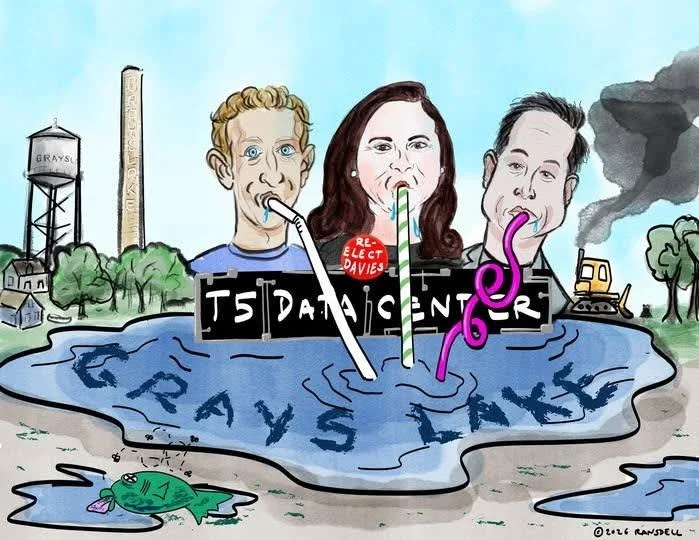
Cartoon by Mitch Ransdell, used with permission.